Showing posts with label visits. Show all posts

Saturday, February 11, 2012

Palm Sunday

Sunday 17th April Palm Sunday
We were blessed with yet Another sunny day which warmed up well. Sunday in the Kolbe household is rather different from what we’re used to. It’s a day for sleeping in and having a substantial breakfast (brunch?) mid-morning! I was feeling a bit sad that we hadn't seen any churches in the neighbourhood that we might have attended (although Bruce wouldn't have understood any of the German), and started thinking about how much people who don't have faith in Christ miss out on in life. Reading the prophecy in Isaiah 42 about Christ's ministry and how people would respond to Him and His message - many act as if they are both blind and deaf and refuse to believe. Just a few of my thoughts on Palm Sunday leading up to Easter!
After breakfast, the computer was back in use again to check the train details for going to Holland. We had only booked the journey back from Haarlem to Düsseldorf the night before as it was a cheaper fare that day. The other ticket would be purchased at Dorsten station.
We sent a text to the Weavers to let them know our arrival details then managed to coax the misbehaving printer into printing off some tickets for us. Jeremy was busy packing up a bag for us to take back to NZ as we had so little luggage ourselves (one bag weighing under 15 kg plus our two small cabin bags!). He and Judith were planning to move to NZ in May and didn't want to have to pay too much excess. Anthony was also going to bring some luggage back with him. The suitcase was quite heavy when finished, but at 22kgs wouldn't exceed our baggage allowance.
It was soon time to go to the station by car, as it is a few kilometres from where the Kolbes live. Most railway stations in Germany have automatic ticket machines which can even print you a rather useful overview of your journey as well as the ticket.
The train was very short and had a diesel engine. We were amazed at wide carriages with fold-up seats. It stopped many times on the way to Cologne, where we had to change trains. We bought some peanut bars from a platform vending machine whilst we waited and coffee on the way to keep us going as there was no time for lunch.
Our first impressions of Holland were good - despite the flatness of most of the land, it is still interesting. There are so many new things to see, from the numerous ditches and canals with their barges and longboats, to the different types of housing.
It was quite cloudy from Arnhem to Utrecht, which seemed a very interesting place to visit. As we passed by a large canal, we saw what looked like floating houses, and an import/export building that had loading doors opening directly onto the water
At Amsterdam, we had to change to a small local train which went from a rather isolated platform that was a very long way for poor Bruce to carry that heavy suitcase! It wasn't very well signposted so it took us a while to find it.
On arriving at Haarlem, no-one was waiting to pick us up, so we sent some more texts, and were picked up after a shortish wait. No-one had picked up our earlier text with our train details!


After dropping off our bags at the Weavers', we were taken on a bit of a tour of the area as the evening was so fine and warm. So we drove to a local windmill, to the statue commemorating what is apparently an English legend about the boy and the dyke and the North Sea Canal where we watched the progress of a ferry boat, which apparently used to be free.
It's so different in Holland from NZ, there are so many, to us, unusual things - the almost omnipresence of bicycles, the narrow, bricked streets with many speed humps (it must be excruciating if you have to go to hospital by ambulance!), the canals with so many different types of bridges, the different types of housing..... Fascinating!

The Weavers spent many years as missionaries in a former Communist country and are now based in Holland running Kairos courses in Europe. It was delightful to see them again, and we had fun having a bit of a catch up on news since it was probably a couple of years since we'd last seen them. After a late tea around 8pm of soup, rolls, and cake we watched Bourne Supremacy before going to bed.

Tuesday, January 10, 2012

A quiet day in Horgenzell

Monday April 11th
We slept until 8 as we were so tired! Oh dear! It was yet another lovely fine day. We didn’t really feel like doing too much, so we walked with Ingrid to Uncle Otto’s to get some potatoes. He runs a small organic farm, which doesn’t earn very much money but provides an interesting lifestyle. His paid employment gives him as much in two to three months as he gets from the farm in a whole year.

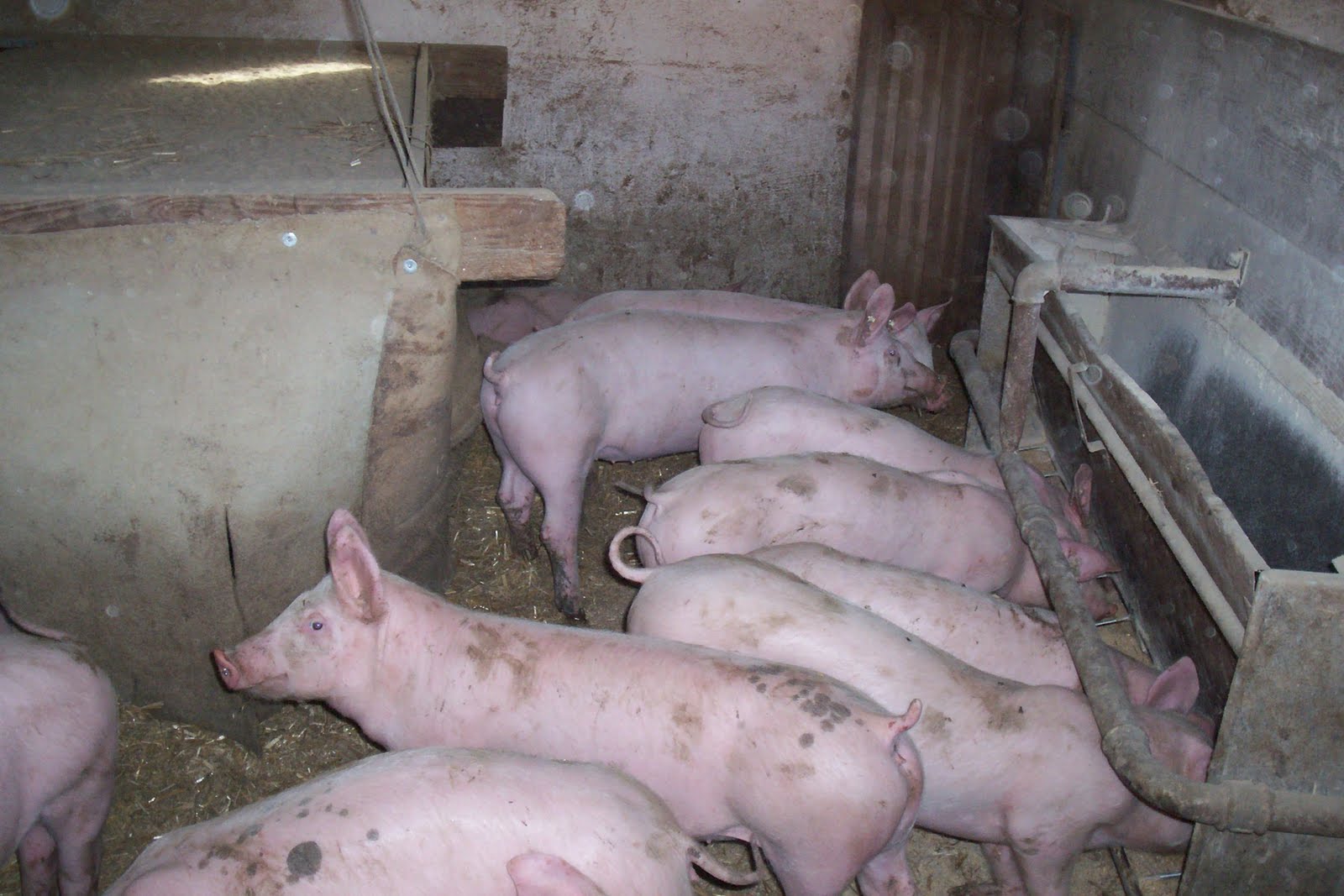
We went into the barn to see the livestock - a pen of zebu-cross steers, and two pens of Simmental bulls (two different age-groups). Another part housed German large white pigs. The boar was huge! The piglets are weaned at six weeks, then sold on for fatterning another six weeks later. The cattle were due to be turned out shortly having spent many months indoors. They are fed a lot of silage when housed, which is quite time-consuming. Someone had had fun carving a log to look like a pig!
Outside again, we started chatting with Otto's wife. It was interesting to hear that their eldest daughter had actually spent eleven months in NZ and Australia, so they were very happy to meet some real Kiwis.
During the afternoon we just read books before going out for a walk around and about Horgenzell before tea. Photos: Kapell church; Typical countryside; "be careful" bear in Horgenzell; memorial near Festewegen.


In this part of Germany there are many small villages (3-400 inhabitants). Many of the houses are surrounded by a small block of land of just a few hectares in size.
Between the villages is farmland, much of it planted our with apple trees, closely spaced and hard-pruned. You can see some in the photograph of Horgenzell below. Each village has one or two businesses, but many people have a job in town to supplement the meagre income from the land. Everyone knows which village to go to if they want a blacksmith, and which one you go to if you want your tractor repairing!
Photos: Horgenzell in the distance; an old timbered house near Uncle Otto's, the Meschenmosers' house.


The houses are quite distinctive, often having three to four floors with a huge roof with eaves that almost touch the ground. The size can be a little illusory as part of the lower floor is often a stable or barn for cattle or other livestock.
Many people are closely related – Bernhard’s relatives mostly live in Horgenzell or in the nearby villages, but Ingrid’s family lives a little further afield.


As it was such a lovely warm day, reaching 22 deg after a cool 4 deg start, we decided to have a barbecue. Bernhard had the job of getting the fire ready, and Ingrid and I had fun making damper - hers from a yeast dough and mine from a scone-type mix, which they really liked. The tripod frame used to be used for stooking hay! The neighbour's Norwegian Fiord ponies were quite interested in the proceedings at times.

Thursday, September 1, 2011

South Germany

Saturday 9th April
We left the hotel not too long after breakfast. It was good that it was so close to Le Midi Station. We bought some food at a small supermarket at the railway station before making our way to the Thalys platform. The journey to Cologne takes less than two hours, and the train is very comfortable. You hardly realise just how fast the train is going. There is a digital display of the speed between the carriages. I think the fastest we went was around 170kph.

The first photo is taken on the way into Liege - the track was quite high above the streets at one point, as you can see. At the railway station was a large globe, apparently there as part of an ecological expo.
We were rather surprised when the train ground to a halt some time before we were due to arrive in Cologne. An announcement came over the loudspeakers saying that there was a problem with a train ahead of us on the line. A little while later, we were told that the track was closed to Cologne due to a demonstration. They first told us we might be delayed by up to half an hour – as there was 40 minutes between our trains, I thought we might just get there on time. But then they started saying that it could take 3/4 hour to get moving again! Oh dear, what to do? I sent our son Jeremy a text to say that we were delayed by a demonstration and that I might need him to phone our friend Ingrid who was going to meet us in Ulm if we missed our train. I only had enough money left on the phone for another text or two.
We started up again 35 minutes after stopping and soon arrived at a small platform (Stoltz Rheinland) that was covered with people – a huge collection of police in bright yellow jackets surrounding a mob of protesters. Apparently they had interfered with a previous train and so the railway company refused to let any more trains proceed until the police had got the demonstrators off the tracks. There were a few announcements about onward connections to various trains, and eventually they came to ours – they said it was being held at Platform 6.
Unfortunately we were one of the last off our train, and by the time we reached our platform, the train had already gone. On looking at the timetable, we found out that the next to Ulm was a whole 2 hours away. I sent Jeremy another text and he agreed to phone Ingrid to let her know.
We had some books to read so that kept us occupied. It wasn’t a very warm day but it was OK. The photos include one at Siegburg/Bonn station, a country town on the way to Frankfurt and two photos in Mannheim. One town before we reached Mannheim was called Waldhof and had some interesting brown and white churches. Further south we passed through some more rugged terrain – in fact it later turned out to be the Swabian Alps. Geislingen was quite a large and attractive town up in narrow valley in the mountains, with plenty of traditional houses with brown roofs and up to 3 rows of dormer windows.
We arrived in Ulm just after 5 to be met by a smiling Ingrid, her husband Bernhard and youngest daughter Friedericke. We decided that, owing to the lateness of our arrival, that we’d just go straight to their home in Horgenzell.
Unfortunately they had already left home by the time Jeremy was able to try to contact them, and the daughter Veronika who’d been left behind to take care of things tried sending them a text – but they had the cell phone switched off! Eventually, after waiting at the station without seeing us, they’d switched it on to phone home to see if there were any messages, and found out that we’d been delayed. So they decided to do a bit more shopping, much to Friedericke’s delight!
We eventually arrived around 6.30, and had a lovely meal. Afterwards, we walked to Kapel, another portion of the little village where their church is. The population of Horgenzell is around 300.

Monday, August 1, 2011

Old Friends

Tuesday 5th AprilAnother disturbed night – dogs, roosters and a thunderstorm from 5 am that lasted up to 9 o’clock. There was some very heavy rain, even some hail.
It was a busy day. Bruce wanted to leave as soon as the rain stopped but I managed to delay him for a bit whilst I wrote some post cards that I’d purchased from BUDAP. We had no success trying to contact mama Hermalinda re visiting her in her village, so decided to go into town. We were due to visit Aristides later in the morning, then mama Juliana for lunch. On the way, we planned to stop by at Harvest.
We bought some oil for mama Petromulaki, but unfortunately didn’t stop in the little soko at Nyakanyasi to buy some flour and a phone voucher, believing that we’d pass a kiosk on the way to Kibeta hill. Unfortunately we’d run out of money on the phone, but had some exciting texts around midday from NZ – our little granddaughter had just started to stand up holding on to furniture (aged 10 ½ months).
We visited the plant nursery by Nyakanyasi River, which was very swollen and flooding the lower ground. The owner has good English and we had a good conversation. He told us that he’s planted 30,000 trees on his shamba!
At the corner where a path leaves the road to lead to the hill, we met baba Jeni – he told us that his wife was very sick and couldn’t come to visit us. He’s expanded his small business of repairing shoes, sandals and umbrellas to serving coffee. His wife has a coffee stall at the market but found that she didn’t get enough custom.
A few houses from the corner is mama Amina’s. She’s an Indian lady whose family came over some time back and she married a Tanzanian and has several children. One of her eldest ones came to Pre-Form One tuition at Harvest, and had excellent English and seemed to be very bright. We’d become friends with mama and she’d invited us in on one or two occasions, and always wanted to stop and chat or give us some fruit from their tiny shamba. Yasintha was home, she was going to teacher training, and had only achieved Division 3 in her Form Four exams the year before. I was a bit surprised, thinking she’d have got Div 2 quite easily. We heard that they only accept boys having Div 1 and 2 results for Teacher Training these days, but they will take girls with Div 3.
Amina went to a neighbour’s across the path and called Deborah out. She’s another young girl who we’d met in Bukoba shortly before we returned to NZ. She told us she wanted us to be her friends, and we write to each other several times a year. She studied at an English medium primary school so has good English, and passed Form Four a year or two ago. Now she is studying nursing at one of the hospitals. She was very emotional when she saw us and it is rather surprising as we only met up with her two or three times, once visiting her home to be introduced to her father who works for the local council.
We arrived at Harvest at 10.30 and were amazed at the huge increase in the number of houses on the hill. People have been building all over it! We were struck again at how unfit we were, and found we got quite puffed and had to stop a few times on the way up! We’d have been even worse if we hadn’t spent 10 days on Bumbire!
We were pleased to see that Harvest Sec School had been able to expand since we were last there, and most of the buildings looked very nice with blue-painted roofs and some nice paintwork on the walls that hadn’t been there when we last saw it. We went to the administration block – that used to be the guest house and pastor Lucas’s quarters, and were amused to see that our former bedroom was now the Director’s room. The building has been split in half – half is for administration and the other half still has some of pastor’s children living in it: three of his boys and one of the daughters. Mama and three of the other children are in Dar es Salaam and pastor does a lot of travelling. The youngest daughter is at University in Dodoma now.
We enjoyed meeting Pastor Theophil for the first time. He is married to a lovely lady called Editha whom we had met on our first African adventure in 2004. At that stage, she was helping mama Lucas with household chores, and was only about 15. On our second visit, we were quite disappointed that she’d gone back to her home village, and was going to get married. Now they have three little children aged 1, 2 and 4.
We were really surprised to hear that four of the Lucas' children (Pastor Lucas is the head of the Agape Christian Fellowship church and lived at Harvest for many years) are still at Harvest, although the oldest three are in Dar es Salaam with their mama. We had a lovely chat with Victory, and she was really sad that we would only be in Bukoba for such a short time. She said we should have stayed for a week, then we could have had lots of discussions and shared views, opinions etc. In hindsight we certainly realised that we should have planned a much shorter time on Bumbire – but Bruce thought it would be good to spend 2 Sundays there to really encourage the pastor – and a longer time in Bukoba, but it had been really hard to organise with only having cellphone numbers for a few of our contacts and in many cases, not getting any news from them at all. Usually the reason is that they have run out of money on the phone or the battery needs charging up!
Pastor Theophil texted mama Juliana to let her know we were running a bit late, and Aristides – as we had no money on our phone – and we were met by Aristides’ eldest daughter, Flia, just outside Harvest. She took us at a great rate up the hill and along the muddy paths past many shambas and small villages till we reached her father’s house. They had been forced to sell their old one and shamba due to a family dispute over the land. Now they are renting two small rooms, part of a larger house. Only the oldest and youngest child are at home at the moment, the other two are in the village with their grandfather as they can’t afford to feed all four of them. Aristides has been out of work since his accident so they have been in serious hardship with only a small income from his wife’s small business. He showed us his artificial leg which he calls Bruce’s leg – perhaps because it’s white! His stump is still quite fragile and was quite swollen and sore – he’s only had the leg a short time so may be trying to get around too much on it.
After a little taro and spiced chai, we went with Flia to mama Juliana’s, not too far away really but Flia got a little lost. She was still busy cooking as we managed to arrive about 10 minutes before she was expecting us! She is still teaching but has to cope with 120 Standard One pupils! These are in their first year of school – just imagine the chaos and impossibility of trying to get any real learning done. She said some of the better-behaved children help the struggling ones, and get somewhere, but quite a few just mess around and don’t learn anything at all. Her daughter Hilda, who studied at Harvest with us, and was my top English student, achieved Div 2 in Form Four, obtaining a B in both Maths & English. She is now studying Maths, Physics and Chemistry at High School.
Mama had let us know last year that her husband was in trouble at work. He’d been accused of being dishonest in his work (he was quite high up in the local council) – but it was a false accusation. He was taken to court and acquitted as false evidence was given against him. However, his boss decided to get rid of him and wrote him a letter of dismissal, claiming that he had indeed been dishonest and had bribed the judges. As he had had no income to be able to do such a thing – he was stood down from work after the accusations were made, the only income in the family was mama’s wages as a teacher, and she was using all of these to try to keep her children in school and to feed the family. So he was now unemployed and struggling to find another job as he wasn’t given a good reference by his employer.
We caught up with some news about others from Harvest Christian Fellowship and found out that two brothers had moved to Mwanza to set up a business. One’s wife had stayed in Bukoba as she was doing really well selling food to the students at Harvest and cooking them food.
Again we heard how sick mama Jeni was, and decided to visit her on our way back into town.
This entailed quite a long, winding route back down the hill. Unfortunately I’d not taken any photos of Harvest on the way up as I’d imagined we’d return past it again and would be able to take photos at our leisure. Teh way to mama Jeni’s took us quite far away into a very rocky area.
She lives in a very small, dilapidated hut, and was really sick. She had been well until after the mkesha on the Friday night, then became really feverish and couldn’t keep any food down. She was also full of aches and pains and could hardly sleep at night, and was too weak to get up and walk anywhere, hardly strong enough to sit up. They thought it was probably malaria. Fortunately she was able to keep fluids down and was drinking plenty of water. They are very poor and she couldn’t afford a trip to the clinic or hospital to get tested and treated. So we gave a donation to help her both get a ride on a pikipiki (motorbike) and be able to pay for treatment the next day. Unfortunately the clinic is only open in the mornings and it was late afternoon. We found out that two of her sons are now away from home selling sodas from handcarts, one is in Dar es Salaam, the other in Mwanza.
We did end up returning past Mama Amina’s again, and went inside for a brief visit as her husband was home and some more of the children. We also saw Deborah again, but she was very gloomy.
On our way back to our hotel, we met Hassan again, he was due to leave Bukoba to travel all the way to Dar and then down into South Tanzania – a very long journey. He was going to go to High School (in Tanzania a High School is where you can study forms 5 and 6 and take A-levels, Secondary Schools are just for Forms One to Four in general). He was very excited to be going with Godfrey, a top student at Harvest. For a while, they both vied with each other for marks, but in the end, Hassan only got a rather disappointing Div 3 result, and Godfrey Div 2.
We arrived back at the New Banana Hotel at 5 and sat outside with sodas. We were surprised to be greeted with the news that two ladies, mama Hermalinda and mama Spia, had come to visit us just after we’d left in the morning. I was really sad to find out that one was Mama Hermalinda who’d come on the bus to see us and invite us to her home. If only we’d stayed in our room a little longer! She’d run out of money on her phone which is why she hadn’t responded to my texts! I’d assumed that she couldn’t come into town for some reason or other.
We booked tea for seven and put our phone on to charge as the battery was getting flat. we were really happy to meet up with mama Spia again after tea. She came back specially to greet us. She has AIDS and seems to keep alive quite miraculously. From time to time she becomes so sick she is close to death’s door, but then recovers again. At least one of her children has the disease also. She was infected by her husband and has been a widow for some years now. Another widow in a similar situation had lost her eldest son to AIDS in January, we were very sad to hear that. Mama Spia and mama Hermalinda live quite close together, so they can encourage each other in the Lord. Mama Hermalinda is also a widow.
Later on we received a phone call from mama Hermalinda and I apologized profusely for not being still there in the morning and for missing her visit. I really did feel bad. We also had some nice texts from Michael wishing us a safe journey. We were to leave Bukoba early the next morning on our way to Europe.

Wednesday, June 1, 2011

Bruce's trip to Rushonga

Wednesday March 30th
I'd managed an excellent night's sleep so woke up feeling somewhat refreshed. The day looked like it was going to be fine at first, but then a thunderstorm arrived at about 9.30, much later than usual - they often seemed to start between 6 and 7. This time the rain persisted until the afternoon.
Filipo and Daniel came for breakfast, which we didn’t eat until 10 am - cold rice and chai as usual - and despite the tablets, I still felt very nauseous and only managed one cup of chai and a few spoonfuls of rice. Usually I'd drink anything up to four cups in the morning, knowing that there'd probably be no more fluids until dinner time unless I drank some water. Pastor had been out early and had bought some fish, but he didn't eat any breakfast; mama told me it was his day for fasting.
Bruce visited Fideli in the morning, and found out that his mother had been diagnosed as having severe malaria, jaundice, and dehydration. She had returned home the night before. We had news that Chris Hamilton might turn up so we were really looking forward to seeing her.
Lunch was quite late, 3 pm, and consisted of fish and rice - really yummy. I was starting to feel much better.
Bruce and pastor left after lunch to go to Rushonga, and got back around dusk. Bruce had bought a bit more time on the phone, so I was able to text a few people to let them know how we were. However, as he'd only bought two 500-shilling vouchers, I had to ration texts as I didn't know when we'd be able to buy any more. We heard from Michael Kikumbo, our Tanzanian son in Dar es Salaam, that he’d passed his English exams, so we were really pleased.
Whilst the men were away, a lady came to visit mama, and I went out to join them for a while. When she left, I chatted with mama for a while about all sorts of things. It was really good, and I was so pleased to be able to sit up for a while without feeling too tired.
Mama is really concerned about Rosemary's future. She says that the secondary school is a terrible place of immorality, and many young girls, even 12- and 13-year-olds, fall pregnant each year. She’d like their daughter to be able to attend a Christian secondary school like Harvest, but the huge drawback is the fees charged. Most families struggle to put their children through the government secondary schools – I think that nationally only 10% ever get to attend – and a private school becomes out of reach for all bar the rich or those able to get sponsors.
Dinner was really nice, we had sweet potato as well as fish and rice. Pastor joined in this time, which was good. Unfortunately I still couldn’t drink a full cup of tea.
The night ended up being a bit disturbed. Pastor had set his alarm for 2 am for prayers - we often heard him and mama waking up in the early morning to pray together. Just at the moment that the alarm sounded, a rat fell off one of the poles supporting the plastic over our bedroom right onto my chest! I let out a small shriek - but was rather relieved that the rat ended up abruptly on the floor and didn't do any running around on the bed! It made it rather hard to get back to sleep, because every time I heard another one on the wall or on the rafters, I got scared that it might fall off again and land on me!
We didn’t have the protection of a mosquito net on this visit. On our first visit in 2006, at 4 am on Christmas Day I was rudely awoken by a mouse just dropping in to say “Merry Christmas”! It landed right on my nose, but owing to the net, bounced off straight away.

Tuesday, May 31, 2011

A trip to the clinic

Monday 28th March
It was cool and windy first thing then the rain came for a couple of hours. Once it finished, it soon became quite hot.
Mid-morning we set off to walk to the clinic. We went around the coastal route as pastor thought the hillier route would be too slippery after the rain. On the way, he popped in to briefly visit one or two people, and we were amazed to come across some really tall banana palms, much bigger than usual. We had a soda as Kiiza's, very welcome in the heat. The picture top right is of flowering coffee, it has a lovely scent. The other photo is of young coffee beans.
This photo shows pastor's boat. He's started up a small business buying up goods and selling them on the other islands. He also sells his own surplus produce. The other boat with two ladies in it was going to be used as an ambulance for Fideli's mother. A group of men had left home once the rain stopped, carrying her somehow. That would be a long and slow journey on foot, much easier once she was in the boat. Her condition had deteriorated further, and really, we though there was little chance of her surviving. Pastor was a little concerned that we hadn't met up with the 'stretcher' party on the way, and kept asking people whether they’d seen them or heard of their passing.
At one stage along the path, we heard the sound of deep-voiced singing, and came upon a group of fishermen hauling in a net. Bruce couldn't resist joining in, but I'm not sure he got the rhythm right! A little further on, we came across another group of fishermen, silent this time, hauling in the other end of the net. Bruce said it was very heavy and really hard work. They didn’t think they’d managed to catch many fish.
Once we arrived at the clinic, we sat in the waiting room until the morning session was completed. We'd met the original missionaries, Dale and Chris Hamilton, back in 2007, and had really enjoyed spending a little time with them. Now they have been sent to Nairobi to head up the African division of AIM. Dale is a pilot and leads the floatplane division, and Chris (short for Christine) is a doctor. The new doctor and his wife come from Texas, and have been on Bumbire for two years (Bill and Dorothy).
There was only an opportunity for a short chat, as they were due to leave the island by boat to go to Mwanza to pick up a trainee doctor, but we were given a warm welcome and a glass of cold water, very pleasant in the heat. They were going to have quite a long trip, as they would have to sleep on another island on the way, and then spend a week in Mwanza before returning to Bumbire.
We arrived back at the Mugaruras’ around 2 pm, not having received any news about Fideli’s mother on the way. We had let the doctor know that she was coming, but as he was going to be absent for a week, she would have to see the nurse, who could do some tests and prescribe some medication. I was feeling rather dehydrated by mid-afternoon and my stomach didn't feel too good after our late lunch either. Unfortunately we'd used up all our water, and pastor had forgotten to ask mama the previous evening to boil us some more.
I started vomiting about 5pm, and it became quite persistent, so mama brought me a basin as I didn't have enough warning to be able to get far enough away from the hut. Filipo, an ex-Bible school student of ours, who, like Pastor Mugarura, had attended Harvest Bible School in 2004, turned up and wanted to have a big discussion about some rather controversial subjects. I eventually had to excuse myself as I was feeling too sick, so poor Bruce was left in the small room listening to a lot of (to him) unintelligible talk in Swahili, as I couldn't translate it for him.
I soon ended up with another problem which necessitated running to the choo, unfortunately at a little distance from the house. I also developed a bad headache. Bruce said that I felt feverish, but I didn’t think it was too bad. Once we had some more water, I tried to sip it mixed with Gastrolyte, but it didn't stay down long.

Saturday, May 28, 2011

Church and visits on Bumbire Island

Sunday March 27th 2011
It was a cool, wet morning, and quite thundery at first. We started the day with a breakfast of cold leftover rice and black tea, also some bread. After the rain had eased off a bit, around 10 am, it was time to go to church. The paths were quite slippery, but we managed to climb the hill without falling over.
It was our first time in the new brick church that we'd last seen in the early stages of construction. On our first visit to Bumbire Island in December 2006, we helped carry large rocks to help build the foundations. These were later concreted by a fundi, but there were some problems. The first fundi to do the concreting asked to have all the money paid in advance - saying that he had some urgent family needs. He then absconded, leaving the foundations only half-completed. The second fundi didn't mix the cement and sand together in the right proportions, so, when we arrived on our second visit in August 2007, parts of the concrete could be brushed off the foundations as it had been made with too much sand. We spent some time removing the poor quality concrete so that it could be replaced it with a better mix. All this cost the small church far too much money.
Between those two visits, the church had been busy making bricks. Some had been stacked all around the site, others needed stacking, and there were some ready to be burnt in a kiln. We took part in the work of stacking bricks and assisting with fetching water to make more. The biggest problem was convincing pastor that we really wanted to help - otherwise we would have been sitting around, feeling rather bored and useless!
Brick-making involves one man puddling away in the bottom of a deep hole in the mud whilst others, including women and children, go to the water source to fetch water in 10 or 20l containers. It was some way off, entailing a walk down the path along the top of the hill, down the steepish hillside through a couple of shambas, and finally down a shortish path to a reservoir that had been built by missionaries. It is filled by a clean spring which then flows out of the concrete-lined pool to form a stream that continues down a narrow ravine, eventually passing below the Mugaruras' shamba.
I tried carrying a 10l container on my head, placing it on a round, twisted grass cap. Unfortunately, I didn't quite fill it right to the brim, trying to avoid getting wet. I thought the cap might come off if there was too much water-pressure on it! The containers were plugged either with a piece of a plant or by fastening thin plastic over the opening with a rubber band. The water moved too much when I was climbing the hill, causing quite a headache and a lot of pressure on my skull. Many of the women carry 20l containers!!! I decided it was much easier just carrying the containers by hand, and ended up taking 2 x 10l the next trip. They thought I was very strong, but I think they are too!
The water is poured into the hole and the soil is trampled in and dug out of the sides as well. Others assist by bringing suitable soil from further away. When the mud reaches the desired consistency, it is scooped up out of the hole and given to men holding wooden forms. The mud is pressed into them and the excess smoothed off the outside. The resulting brick is pushed out of the mould onto the ground and placed on one side to dry.
The bricks have to be turned from time to time until they are dry enough to stack. The stacks are about 1/2 metre high; the bricks are placed loosely, first lengthwise in two rows, then the next layer crosswise. We helped do this one day. Each pile ends up being covered with an umbrella of dried grass so that rainwater is shed. If this isn't done, the unburnt bricks start to crumble and dissolve!
After a while, the bricks are restacked, as different layers dry at different rates. Eventually they are built into a kiln, and a fire lit inside to burn the bricks. The process can take quite a long time.
On this, our third visit, the church had been in use for some time, and already the site of the former church had become overgrown with young trees and vegetation. It was hard to discover where it had been. We were really a bit sad that they had decided to build a brick building; we had really enjoyed the atmosphere of the traditionally built thatched one, and thought that the traditional method is so practical and cheap to put up, using local renewable resources. The biggest problem would have been maintaining the thatch so that people didn't get wet in the rains, and replacing the walls if/when they get destroyed by ants or termites.
The new church had been roofed with iron sheets - a big expense - but the Agape church provides its churches with these if the congregations do the rest of the work in building the main structure. Swallows had built a few nests under the roof, so were flying in and out as we held the service, which was quite fun really!
There was only a very small congregation at first: us, the four Mugararas, and the faithful elder, Daniel. However, after an hour or so, several other people turned up, including lots of children, so the total congregation was 18. I was asked to translate Bruce's sermon and managed pretty well, although I got a bit stuck on a few phrases so was glad that Pastor was able to help me out.
Lunch was rice and chicken (the same as we'd had the previous night) - but there was nothing offered to drink. Fortunately we still had some water in our room that we'd bought in Bukoba. After lunch, we went down the steep path to the stream, crossed it (you have to take a big step or small jump across from one rock to another then clamber over slippery tree roots to meet the path on the other side), and then climbed up the path to Fideli’s house, one of the next-door neighbours.
Pictured are Fideli and his wife, Pastor Kaserwa (from the mainland) and Bruce, photo taken December 2006. We were amazed to find out that Fideli now has five children: three boys and two girls. He only had the three boys when we last saw them in 2007: Mika, Meshaki (called Meshaki 1 to distinguish him from the Mugaruras' Meshaki), and Melkizideki, who was nearly a year old when we left and was not yet walking, much to everyone's concern. They told us that most babies start walking at around 8-9 months old! Melkizideki had taken everyone by surprise by weaning himself at 9 months of age; usually the babies are fed for 2-3 years or at least till the next one is nearly born. He obviously hadn't been getting the right kind of diet as he was quite small and seemed rather lethargic.
It's very hard for the locals to provide the right mix of protein, fat, carbohydrate and vitamins for newly-weaned babies and toddlers. Meals are based mainly around starchy staples. Meat, poultry and fish are very expensive so aren't eaten very much or in small quantities, and fresh fruit and veges don't feature very strongly in the diet. If you have your own shamba you try to grow as much of your own food as you can, but many things are seasonal and can only be eaten out-of-season if you can get to a market that brings in foods from other parts of Tanzania where the seasons are different. The mchuzi – a soup-like liquid served in a bowl, sometimes one for each person - usually contains onions and tomatoes, but these might be the only veges eaten in a day if you don’t count the starchy roots such as cassava, taro or sweet potato. If meat, poultry or fish is cooked, the cooking liquid becomes the mchuzi.
All of Fideli’s children are very friendly, well-mannered, and quite delightful, and were very happy to see us. I amazed them (and myself!) by correctly identifying Meshaki. Fideli's mother was very sick, and was in the vestibule lying on a mat on the grass-covered dirt floor. She was very weak, and although she did manage to sit up, could hardly walk. Mama Mugarura helped her outside at one point - presumably to visit the choo, and that seemed to completely exhaust her. We were told that she'd been sick for about 6 weeks, had a high fever, wasn't drinking properly, and couldn't keep any food down. They had tried all kinds of treatment without success, including antibiotics, so were discussing whether to take her to the clinic run by African Inland Mission the next day.
Most of the local huts and houses have a kind of vestibule or room just inside the front door where visitors sit, usually on mats. Fideli's house is quite large, so this room could seat quite a good number of people. There was a lovely clucky hen in one corner sitting on some eggs - this is quite common! In one house, we were very amused to see a hen sitting on one of the chairs! When you visit, you are usually offered some kind of food or drink - we were offered some fresh pineapple - yum!
Once we'd finished our visit, mama went home, but pastor, Bruce and I went down another path and crossed the stream further down. After a good walk around the side of the hill, through a section of bush, then down a rockier path right to the lakeshore, we arrived at Kiiza's house. His brother was the one who had provided us with sodas in Kemondo. Kiiza offered us cold rice and spiced tea - yummy! We had a very nice conversation, and he expressed a desire that we'd stay in Tanzania and build a house on the island! He doesn't have a very good source of income, and has a wife and two children to feed. Sometimes he can earn a little cash by carrying burdens for people at the landing stages, but mostly they survive on what is grown on his shamba. He is living in a very interesting home, it has belonged to the family for some time, I think, and may have been built by Germans. The doors are solid timber, quite ornately carved wood, and the house looks solidly built of well-laid bricks and is quite large - but the vestibule had obviously been added on at a later date, and the concrete floor was parting company with the rest of the building!
It was quite hot on the way back to the Mugaruras’, and some time after we arrived back, the children returned with their two goats. The goats are tethered for many hours during the day as well as all night, but once a day they are taken down to the stream for water and up the hill for grazing (usually the children’s job). Meshaki lost his goat this time, he finds them rather hard to hold - but I managed to catch it for him.
We had quite a late dinner with Daniel - rice, chicken and tea again. Unfortunately I felt a little nauseous after drinking some tea, so decided to be very careful how much I ate. We ended up going to bed close to 10 pm.
The evenings close in quite early; darkness falls quite abruptly around 7 pm, and with no electricity, it's impossible to read - although pastor likes to try, using a torch. He now has a rather interesting battery-powered lamp that resembles a kerosene one in shape and size. Unfortunately the light it gave barely enabled you to see what you were eating, so if Pastor wanted to read, he had to use a torch as well!
I was glad to have a much better sleep; there was no wildlife for quite some time, although I woke up briefly in the early morning to hear rats running around in the house.

Tuesday, October 27, 2009

A trip to Isanzu

Thursday July 23rd The day started slowly, bibi was cooking rice for breakfast, and Michael catching up with his washing. As the house floors looked very dirty, with lots of puddles of wax and scraps from tea, I decided to do some sweeping - and for once, no one else had the grass broom! Once that was done, I found a twig one for outside, happy to relieve Michael of that chore to spare his sinuses, but it took ages, 1½ hours! Bruce was collecting & chopping up firewood for bibi, but as they don’t store it till it’s dry, the fires are terribly smoky and inefficient. Bibi reckons it’s the smoke that’s damaging her eyes, every so often they get very sore & weepy & she can’t see very far. Some passers-by were amazed to see us working, so bibi told them, “They’re the children of the household.”
One day she said if I was Michael’s mother, then I was her daughter & Bruce her farmer! She’s even offered us a piece of land to build a house on! Michael wants us to build a BIG house with four bedrooms so all our children can stay – but we said we like little houses, or could build a big one so he & his wife & children could live in it with us, but he didn’t seem so keen on that idea! Lots of people have asked bibi to sell them a piece of land but she’s keeping it for the family. If she dies, Mama Joyce will oversee it as oldest surviving child. Each member has their own portion to garden but any one of them can build a house there & live on the shamba, including us!
Whilst Bruce was away bathing, I took a photo of little Michael, Ibrahim, Jeremia and Michael outside the old house. Enock turned up just as Michael finished in the bafu. I sat in the back with the two Michaels and Jeremia, Bruce in the front. It's only about 1/2 hour to Isanzu by car, it's the other side of Nzega. I was glad that Enock was the only driver, the car seemed to slide a bit in the dust as he veered around the obstacles, tooting his horn to clear the way!
Isanzu is a tiny collection of dwellings and a small duka or two. Babu Mathias and Bibi Belta live on a shamba down a short track off the 'main' road. There are several traditional huts dating from the time all the family lived there. Babu is one of Michael's great-uncles.
Bibi was practically jumping up and down to see us, exclaiming, “It’s just like a dream!” over and over again. She was absolutely overjoyed to see Michael again, he is much loved by many people. We were taken inside a hut and sat together in one of the two rooms. The home-made wickerwork chairs only just squeezed through the doorway! After a nice chat with babu we ate lunch together.
They have five children: Rachel is Pastor Jonas Kulwa's wife, Musa is a carpenter, Zahabu is another son, Esther works in Dar and Neema is married. Bibi came from Mwanza originally, so Babu has been to the Sukuma-style Catholic cathedral there. After lunch, we talked about the Sukuma language. Michael found a hymn book and New Testament that had an extra portion including the Lord’s Prayer, the Apostle’s Creed and the Ten Commandments. He read them out & I copied - fun! Then he wrote the Lord’s Prayer on a piece of newspaper, I tried reading it out loud by myself apparently quite correctly - everyone was amazed, they find it terribly hard to read Kisukuma, they’re only used to speaking it, early schooling is done in Kiswahili.
Later on, we sat under a large mango tree chatting before going for a little walk through part of the shamba, which produces peanuts, maize and sisal. There are also mangoes & various palms, including dates & one with fruit resembling large coconuts that contain a large edible seed full of oil. The well was dry but Bruce thinks it just needs digging deeper. Nearby was a clump of straggly rosella plants.
Back at the mango tree, we were shown the long poles in its fork bearing maize cobs - a traditional method of storage. Nearby, sisal leaves and fibre were in various stages of preparation for weaving into rope or making other things.

Pics: left = Baba Enocki, Babu Matthias, Jeremia, Bibi Belta, Michael, little Michael, and Bruce outside one of the huts; right = Jeremia at Isanzu;
On the way back to bibi’s mid-afternoon, we stopped at the attractive-looking orphanage to meet the children plus another staff member. Unfortunately, little Michael didn’t want to get out of the car to play with them.
Back at bibi’s, we were given a large bag of peanuts to shell – I found it quite difficult, only doing one nut to Michael’s five, and my fingers got really sore! After a short break, Michael showed me how to do it properly & suddenly I could almost keep up and didn’t get sore at all!
L = ‘Michael in the bush’ (the bougainvilleas at bibi’s).
Eventually he decided he'd had enough, so after taking a photo of him 'in the bush', we walked up to the large rocky hill in the distance, where little Michael had had fun the day before sliding down the rocks.
It’s a little way from the shamba, down the Tabora road, and is quite impressive – the rocks rise up sharply off the plain behind a collection of a few huts and a couple of dukas.
It was a bit of a scramble to reach the top, but once there, there were lovely views over the surrounding countryside - bibi’s is way in the distance just past a dust cloud on the left of the road, top right!
As dusk was coming, we climbed back down an easier route, returning to the road via a different path to enter the shamba via the short driveway behind the new house, edged by attractive native trees that babu left when he cut down the rest that were growing in this part of the shamba; Michael says they look lovely when they flower in the wet season.
Shelling peanuts continued even after dark, sitting round on stools outside the porch of the old house, where bibi was preparing rice. Mama Lucia’s oldest girls turned up a bit later.
We had quite an interesting and varied conversation – Michael said he’d tar-seal up to bibi’s house & put in pipes running with milk if he became an MP!!! Bibi said her 12-15 goats won’t be enough for the bride price for five grandsons, but I said there were only two really needing them: Michael and Jeremia as they have no parents. Also the other three are a lot younger, although the 3rd Michael (yes, another one!), Mama Regina’s oldest son, is in Form 4.
After a rather late tea with all mama Lucia's daughters, their mother, and a young Uncle John, we had a short time of fellowship together before going to bed around 10. However, I was kept awake by the guys shelling peanuts in the sitting room – still! I thought we’d finished them!

Harvesting rice

Wednesday 22nd June Michael swept the area around the houses today, and I’d never seen it so immaculate! Bibi said she only had a little work to do so didn't need my help, so I sat outside with Bruce who was working on a message for bibi’s church in Nzega – we’d been asked to go there in the afternoon as we hadn’t gone on Sunday. We were surprised to see some mamas going along on the path near the house, carrying small dishes of white stuff - Michael told us later that it was flour. Someone had died in the village and it was time for people to pay their respects. One lady came to get flour from bibi, then another one came by to invite bibi to accompany her. Breakfast was buns and chai today, then Michael and I looked at photos indoors, from when his grandfather was a young man to Michael's time in Bukoba at Harvest. It was interesting seeing more pictures of Michael as a baby, his baptism age 15, working in a store after he left school. There were a few from his time at Biharamulo Teacher Training College. Only three of the students were men, the rest women, who wore a uniform of pale blue skirt and white blouse; the men wore a blue & white striped shirt over whatever trousers they had. It was interesting seeing the dolls & Ludo boards they had made. There were some nice photos of Michael relaxing on a rock near the school, also one of his first class of five little students at Harvest, Bukoba. I recognised two of them who I'd taught on occasion – a very difficult job! Bibi came in, urging him to hurry up as he was needed to supervise Ibrahim and little Michael, who’d gone to the rice shamba. She looked surprised when I went with the men, perhaps she'd hoped I'd stay and help her or chat. On the other side of the Tabora road, a footpath wends towards the paddy field past a short path to the village pump. Rice is grown in small rectangular plots surrounded by thorny, weed-topped mud walls. Ibrahim had already cut a few bundles using a small sickle, but Michael took over. Little Michael was just messing around!Bruce had a brief turn at cutting the rice, but found the bending too much for his back. Once there was a big enough area cleared, we laid a large tarpaulin down, lining up the cut bundles along one side. Threshing is done by picking up small bundles and hitting the heads against the tarp or a stone to dislodge the dry grains. Ibrahim used another method, laying several bundles head to head on the tarpaulin, then beating them with a large stick. Once we’d finished the first bundles, Ibrahim was kept busy collecting them from Michael, bringing them over to us to thresh. Little Michael ran back off to the home shamba, although he could have made himself usefull carrying bundles or chasing the neighbour's straying calves away. 1½ hours later, we'd cleared two plots and needed to return to bibi's as we had a lunch engagement. Shaking the grains into the middle of the tarp, we skimmed off the rubbish before pushing the rice into a sack for Michael to carry on his back, it was about 15 kgs.Bruce went over to the pump to see if he could help the youngsters drawing water, he thought they weren’t pumping it very well – but soon found the seals were too worn to pump any other way. The mamas at the intersection greeted us, commenting about how tired we must have got from all our work in the fields - but I said it was very enjoyable! Bibi also thought we’d be tired, but really we were fine! We had got pretty hot though, so were glad to bathe before going to Paulo’s. I had to laugh, Michael trotted out just in his shorts looking slightly embarrassed – briefly! Paulo’s is only a short walk away. The big wrought-iron gate opens into a small courtyard between the house & other buildings. We had a lovely time there, good food and good conversation! Mama had made a very tasty mchuzi and a delicious side-dish of ground peanuts/tomatoes/salt. She'd prepared both ugali & spaghetti, perhaps fearing we wouldn't like ugali, but we quite like it!
Afterward, we chatted with Paulo, Michael chatting with his aunt. Paulo says if you put the two of them together, it’s hard to stop them talking!!! He used to clean and maintain the swimming pool at the Swedish school until it closed, working every day from 7 a.m.. Alternate days finished at 2 p.m., the other by midday. The one hundred students were taught in Swedish, but they picked up Kisukuma playing with the local kids - it’s a Sukuma area. The adults also picked it up instead of Kiswahili, causing a few problems for those working at the hospital - some of the other staff plus patients were from other tribes!
The pool now only gets used by visiting Wazungu, Africans don’t normally like to swim – probably a modesty issue re togs, although the men seem quite happy to bathe in a river in a secluded spot! Woman aren’t allowed to show the thigh or midriff though. Paulo picked up Swedish so well that visitors often ask him when he’d visited Sweden! He now works as a Bible College watchman, having on a rotating shift: Day 1: 7 p.m.-7 a.m.; Day 2: 7 a.m.-3 p.m., Day 3: 3 p.m.-10 p.m. He also sells phone vouchers from home and at the bus stand, making about 20% profit. His children help, he says it’s good training for them to take part in a small business; too many young people are becoming lazy, sitting on benches drinking & smoking, saying there’s no work! In the old days, that’s what the old men did. He says the young ones are drinking their strength away, so if they do find work, they can’t do it anyway! He says there’s plenty of work if you go out & look for it.They only have two children, Happy (Form 2) & Matthew (S6). Happy didn’t want to go to Nzega Day School, so they found her a place at Umoja Sec, 100 kilometres away in the bush. She didn’t want to go there as she’d heard tales of lions, snakes & hyenas!
She phoned up after just a week there, wanting to come home: there were wild animals, and she had no friends. But she’d never actually seen any wild animals, just heard a hyena one night! She agreed to finish the term.
They discussed it again in the holidays – by which time she loved it – great teachers and great friends! However, her brother wants to go to Nzega Day, he thinks they study too hard at Umoja! Paulo wanted to know if we’d like to use the sauna - they all laughed when I said I thought it could be dangerous, one could get too dehydrated, and also I don't like the idea of dripping with sweat! It might be one way of keeping warm in a cold climate though, but Africa is too hot!
We had to be back to bibi’s by 3 so that we'd be in time for church at 4. We were met by another visitor, Michael's younger brother, Jeremia, who gave us both big hugs. He’d come on the bus from Igunga where he lives with Aunty Joyce. Aunty Lucia there too, telling us Uncle Enock would take us to Isanzu tomorrow.
After getting our Bibles for church, we waited outside for bibi, who came dressed in a fancy blouse. I must say I was a bit shocked to see Jeremia start to unbutton it, especially as she had nothing on underneath - but he was only trying to help, she hadn’t done them up properly!!
We got to church on time, but of course it left no opportunity to go to the net. Poor Bruce had got overheated AGAIN, so Michael went off to buy water while we waited in the church office for the service to begin. Some of the elders greeted us and we signed the visitors’ book; the pastor was away visiting a bereaved family in another village.
The service started 40 minutes late as no-one turned up apart from the elders till then, so we could have gone to the net after all! The elders quipped that they should only wait ½ hour then lock up & go home - that’d really confuse the latecomers!
The new church is really large but isn't finished yet. They say it is full on a Sunday. The old one is only used for Sunday School now. However, only about 20 turned up for the mid-week service. Naturally it’s hard for workers to get there, so most were elderly like bibi.
The teaching on prayer was excellent, given by one of the elders, a school teacher, as part of a series. He translated the odd phrase for us, I quietly did the rest for Bruce. At one point, he used Jeremia in an example of the believer’s close relationship with Christ, walking arm in arm around the front of the church - Jeremiah (Jesus) even stroked his face and shoulders! It was quite funny!
Bruce was given a short opportunity to share, I tried translating, but the teacher chipped in to hurry things along, going away like a rocket! I would have preferred him to have done it all really!
We greeted everyone afterwards, including a blind evangelist, whose prayer isn’t to receive his sight, but rather to be used more by God.
It took an hour to return via the dirt roads; the dust upset Michael’s sinuses so he had a rather disturbed night. Little Michael got into big trouble from bibi for something later on, I think he'd been playing with the candle indoors.
Once it got dark, we were asked to wait indoors while Michael went to Mama Lucia’s to see how much Baba Enocki would charge to go to Isanzu, but the shrieks and laughter from the girls outside made me wonder just what was going on, and I think he was a little late leaving - although of course it could have been Jeremiah that was causing all the commotion! I wasn’t sure if we should go out to join the fun or stay in, it was pretty boring inside!
Michael was just back in time for our late dinner, saying we’ll only have to pay for seven litres of petrol, half the cost of a taxi. He said we could all take turns driving as we all could drive!
Michael of course had done a one-month course last year, and Jeremia a six-month one some time ago. I must say I didn't really want to – but driving on rough roads veering round potholes, livestock, cyclists, pedestrians and the occasional car, bus or truck – no way!
We were a bit shocked to find out that you can get a licence just by paying a fee, without having ever driven, had lessons or studied the road code! No wonder there are so many accidents! Jeremia would like to get a commercial licence but it costs 100,000Tsh and Michael thinks it’s too dangerous being a taxi driver anyway, lots die every year especially in Dar from hijacking – I was thinking they just died in accidents!
We found out that Michael hadn’t started primary school till he was nine, which is why he finished so late aged 16. In the year 2000, the government developed a new scheme of special schools for such late starters, so that they could complete an abridged syllabus in just two years, instead of the normal seven.
We were interested to hear that Jeremia can play the piano & loves classical music, he plays keyboard at church but of course has no instrument at home to practise on. He'd like to find his own place in Igunga. At present he's at Aunty Joyce's, where he’s started a chicken farm with 100 hens (local & European) that are laying well. He started it there rather than Tazengwa because there are more opportunities to sell eggs. We were all disappointed that we didn't have an opportunity to visit it.

Thursday, October 15, 2009

Strange English, bibi's house, God's protection

Tuesday July 21st I felt really tired in the morning, it'd been hard to get to sleep, and I woke too early. I was also disturbed during the night by someone else having trouble sleeping, their bed creaked each time they turned over! However it was a nice morning, a bit warmer as there was no cold wind.
After a breakfast of peanuts + chai, I briefly looked at 2 English books Michael’d been given a few years ago. The first was written by a Kenyan Rastafarian and had Kiswahili-style pronunciation guides for each sentence. I tried reading one out loud and sounded rather African! The second was written by a Tanzanian in supposedly American English, but had some very strange phrases, such as: “Would you mind standing in camera?”!
Michael helped me understand some Kiswahili words I'd been having trouble with using his dictionary; he’s a good teacher. Bruce was busy reading the CHE book. Soon it was time to farewell Mama Joyce + Maria; Mama Lucia came to say goodbye too.
Michael showed us around the old house, he’d like to renovate it to use it as his own home. It'd be too expensive to knock down + rebuild. He actually helped the builder build it, acting as his navvy: fetching water, mixing clay plaster, carrying bricks.
Past the porch where bibi cooks, you enter the living room. A bedroom is on one side. A second door leads into what was a food preparation cum dining room and another bedroom. The door to the now-vanished outside kitchen has been bricked--in, as has a window. A long narrow store room stands between the old dining room and the main bedroom, which also has another store room on one end.
Some of the walls have huge cracks running through them, others have been filled with plaster. The aluminium roof has huge holes in it (it replaced the first roof when that started to leak). It'd be a big job to renovate it!
Before having a small lunch of ugali and mchuzi at noon, we looked at a model family tree to discuss names. Michael said we would eat two dinners later on!
Michael took me to the pool at the far end of the shamba near the damp depression where babu wanted to dig a well so I could do my washing. Bruce stayed behind, but little Michael tagged along, not wanting to play with the neighbours’ children. As he hadn't brought his dirty clothes with him, 'our' Michael had to go back to get them! After I finished our clothes, I washed their trousers whilst Michael did their shirts!
We met Bruce on the way back, he must have been wondering what had taken us so long! He’d been planning house renovations, so we went back to have another look before he put them on paper.
We were surprised to be offered cucumber + bananas at 4, thinking of our 2 dinners that were coming up, but ate them all the same to keep bibi happy!
Our first engagement was at the Kulwa's, but pastor was resting in a singlet! He'd had malaria for a week & his wife came home with it too. She’s on hospital medicine, but he’s taking papaya seed tea, a local remedy.
We looked at more photos, and talked a lot over dinner. He invited Bruce to teach a 5-day seminar on our next visit, and he'd also like a church team to come to do village evangelism, there are lots of unreached places near Nzega.
We were surprised to hear it’s unsafe for Wazungu in many parts of Tanzania these days, even in Ipilili after dark! We'd thought it was only in cities like Dar & Arusha, or near the borders with Rwanda, Burundi + the DRC.
He told us the following story. In June, he invited a man into his home as he said he needed to talk. He and 3 others had planned to raid the house in April, when the Kulwas had Wazungu guests. One was armed with a rifle, another with a pistol & they were prepared to kill someone if necessary.
As they approached the house, they heard the sound of people marching towards them, so they ducked round the corner. Everywhere they went, the sound followed them, so eventually they ran away. This man had been so upset that he eventually decided to confess to the pastor, & to ask about who was protecting the house.
Jonas told him there were no bodyguards, only God. The man wanted to know more, and ended up becoming a Christian. He's now an active baptized church member, and led one of the other thieves to the Lord who'd been imprisoned for another crime. Now the other prisoners are hearing the gospel!
Jonas was amazed hearing Michael speaking a little English, and gave him some simple greetings to translate for Bruce. He was so successful that we told him he’d soon be translating in church!
On the way to Mama Lucia's for our second dinner, we visited another pastor’s house. As he was out, we chatted to the two men sitting outside: another uncle + a friend of Michael’s, who said that Michael’s his pastor! Bibi had told me that lots of people call him that because he studied the Bible so hard by correspondence that he was able to advise & counsel many people in the village.
It was dark before we arrived at Mama Lucia’s so Michael helped me again, the pathe was really stony. We met her husband Enock Kakole for the first time. He works at the new orphanage opened in June by the Mission; before that he worked with the children at the Swedish school for 15 years, then at the Bible College for 5.
We watched news on the TV for a while, run by a small solar-powered generator, then we discussed the best way to get to Isanzu in two days time to visit Babu Matthias (a great-uncle). We wanted to walk to save money; Michael had said it was only 12 kms, and would cost 20,000 Tsh to go by ca, but bibi had been horrified and said it’d take 3-4 hours! We thought if we left first thing, we could arrive by lunchtime, & get a car back – BUT there are no vehicles in the village. Enock said he might be able to take us, and would let us know the next day.

Divine appointment in Nzega

Monday July 20th  Windy/cold at first, hot later.  Michael showed us an old letter he'd been sent by a USA Bible College re a pastor’s course.  Even back in 2003, the fees were a total of USD 14,000 for one year live-in, with only 10 hours' guaranteed teaching time per semester!  Overseas students in difficult circumstances could do it by correspondence as long as their home church would guarantee the tuition & book fees.  Then he showed us his chekechea teacher-training certificate from Biharamulo.  He studied there from 2005/6, a Swedish missionary paid his fees.  He also showed us last year’s one-month driving course certificate.  He'd been a bit disappointed by his results, but we told him it’s hard to learn to drive in such a short time.
Mid-morning, we walked to Nzega through lovely countryside, passing an English Medium Primary School in the town outskirts.   We met lots of Michael’s old school friends, and sat in the shade of a veranda outside a guest house owned by one of them.  It was being renovated so they had no soda to offer. 
We were surprised to be waved at by an Mzungu in a passing Land Rover which then stopped.  She came over, asking Michael in excellent Kiswahili who he was, before introducing herself as the Finnish missionary who employs Mama Lucia as cook and housekeeper!  As they hadn't been in Tazengwa for very long, and only stay there for breaks from their work 100 kms away, Michael had never met them.  We ended up being invited for coffee at 5!  It was truly a ‘divine appointment’, they’d only got back the night before & were to leaved again the next day!
As we were feeling thirsty, we went to have soda + buns at a cafe before going to the internet.  We met a young boy on the way, who looked about 8 but was 11.  He spoke really good English, and asked Bruce SO many interesting questions!  Great fun! 
Unfortunately I'd accidentally left my notebook in our room, so couldn't upgrade our seats as I didn't know our Skywards numbers.  We were able to read some emails at last as I eventually managed to find Xnet's new webmail address.
We then went to book seats for Friday, but only paid half the fare: if you pay it all, they might resell the seats!  After that we went to the Post Office to buy post cards – but they don't sell them!  Bruce was suffering from the heat again, so we didn’t want to walk back through town to find a bookshop and to go to the market (soko) to buy bibi some fruit and vegs. 
We heard whistles being blown & marching - along came a team of women dressed in bright uniforms, advertising a concert.  They were all smiles when I greeted them in Kiswahili!
On the way back, we eventually found a roadside stall where we bought some tomatoes, cucumbers, green peppers, onions + bananas.  Further along the way, we bought a huge pawpaw, then at a kiosk, we bought Michael a new toothbrush, some toothpaste and candles.  He'd accidentally left his toothbrush and toothpaste at Rosa's and had used up our spare airline set.
We reached home at 3 and had lunch an hour later, a good thing we'd had a snack in town!  After a brief break, it was time to go to the Swedish Mission.
The first Swedish missionaries arrived in Tazengwa in 1932 and started a school for Swedish missionary kids from all over Africa.  It closed 5 years ago, but reopened as a Bible College for training African pastors up to degree level.  It's now solely run by African staff.We passed Michael's primary school, which is two blocks of classrooms set in sandy land - one block is shown in the photo (top left).  The monument (above) across the road is in memory of the first Swedish missionary, and nearby is the FPCT church (left) where babu was the 2nd African pastor.
The mission compound is surrounded by a tall netting fence, a thatched kibanda houses a security guard just inside the large gates.  The grounds are attractive, and you follow a broad, smooth, sandy drive towards the large thatched house. 
No-one answered our calls at the front door, so we went round to the back.  The noisy generator had drowned us out.  Hanna Väyrynen + Lucia were in the kitchen, but sent us back to the front veranda to eat & drink together: home-made Finnish yeast buns, spicy biscuits + real coffee (Kenyan) or tea if you preferred. 
We had a lovely time with Markku + Hanna, who practiced her English so Michael felt a bit left out.  Bruce said now he’d know how he feels!  We were surprised to hear that Finnish is quite similar to Kiswahili so they pick it up fast; they find English very hard to master.
We shared about our backgrounds, families and work in Africa.  Hearing about the Maasai’s problems, they lent us a book on a Christian community development programme (CHE) that they use.  It's used in many countries and seems to be really effective.
It was lovely to find people with hearts like ours, and who see the problems of the typical African mindset of depending on outside help, and wanting to have bigger, ‘better’ churches – i.e. more Western-style, instead of being content to use what they have/can afford. 
We went home via another babu’s place.  As a retired Primary School teacher, he has good English.  He thanked us several times for helping Michael study, saying the family wants to help but don’t have the resources. 
I was really touched when Michael took my hand on the way home, leading me round the stones and dips in the path - it was dark, we had no torch, and I don't see well in the dark.
It was a big gathering for tea, including Mama Lucia + her girls.  We had rice, curry, bananas + cucumber, then a time of worship together.  Pic: Mama Joyce, her daughters Maria & Editha, little Michael.